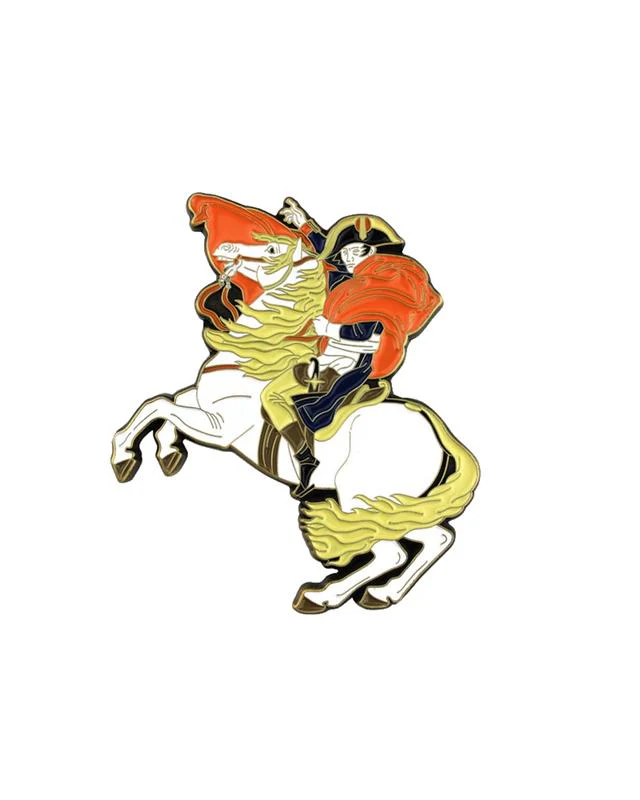
Napoleon Crossing the Alps Enamel Pin
2.4" x 2" Large Soft Enamel Pin Triple Posted Rubber Clasps Inspired by "Napoleon Crossing the Alps" by Jacques-Louis David Jacques-Louis David (1748-1825) was a French Neoclassical painter well-known for his politically and morally charged history paintings. His famous depiction of the French ruler Napoleon Bonaparte, "Napoleon Crossing the Alps" (1801), applies the conventions of academic history paintings to a contemporary subject. The painting celebrates Napoleon’s actual crossing in a highly idealized manner, depicting him much younger than he was and on a horse when in reality he had ridden a mule. The surrounding landscape strategically serves to center the authority of the heroic Napoleon.
Original: $20.00
-65%$20.00
$7.00Napoleon Crossing the Alps Enamel Pin
2.4" x 2" Large Soft Enamel Pin Triple Posted Rubber Clasps Inspired by "Napoleon Crossing the Alps" by Jacques-Louis David Jacques-Louis David (1748-1825) was a French Neoclassical painter well-known for his politically and morally charged history paintings. His famous depiction of the French ruler Napoleon Bonaparte, "Napoleon Crossing the Alps" (1801), applies the conventions of academic history paintings to a contemporary subject. The painting celebrates Napoleon’s actual crossing in a highly idealized manner, depicting him much younger than he was and on a horse when in reality he had ridden a mule. The surrounding landscape strategically serves to center the authority of the heroic Napoleon.
Product Information
Product Information
Shipping & Returns
Shipping & Returns
Description
2.4" x 2" Large Soft Enamel Pin Triple Posted Rubber Clasps Inspired by "Napoleon Crossing the Alps" by Jacques-Louis David Jacques-Louis David (1748-1825) was a French Neoclassical painter well-known for his politically and morally charged history paintings. His famous depiction of the French ruler Napoleon Bonaparte, "Napoleon Crossing the Alps" (1801), applies the conventions of academic history paintings to a contemporary subject. The painting celebrates Napoleon’s actual crossing in a highly idealized manner, depicting him much younger than he was and on a horse when in reality he had ridden a mule. The surrounding landscape strategically serves to center the authority of the heroic Napoleon.